Executive Summary
High-Density Executive Summary:
This analysis highlights the comparative advantages of Tesla and Rivian for 2026, focusing on practical benefits and their impact on skin health.
- Tesla's Advanced Battery Technology
- Rivian's Innovative Electric Vehicle Design
- Environmental Impact on Skin Health
Key Takeaways:
- Tesla’s Superior Range and Charging Infrastructure: Offers longer driving ranges with faster charging speeds, reducing range anxiety.
- Rivian’s Body-on-Frame Construction: Provides better protection for the battery and passengers, enhancing safety.
- Both Companies’ Commitment to Sustainability: Reduces carbon emissions, which can lead to improved skin health by minimizing exposure to pollutants.
Expert Analysis: What is Tesla vs Rivian (2026): Which One Is Better??
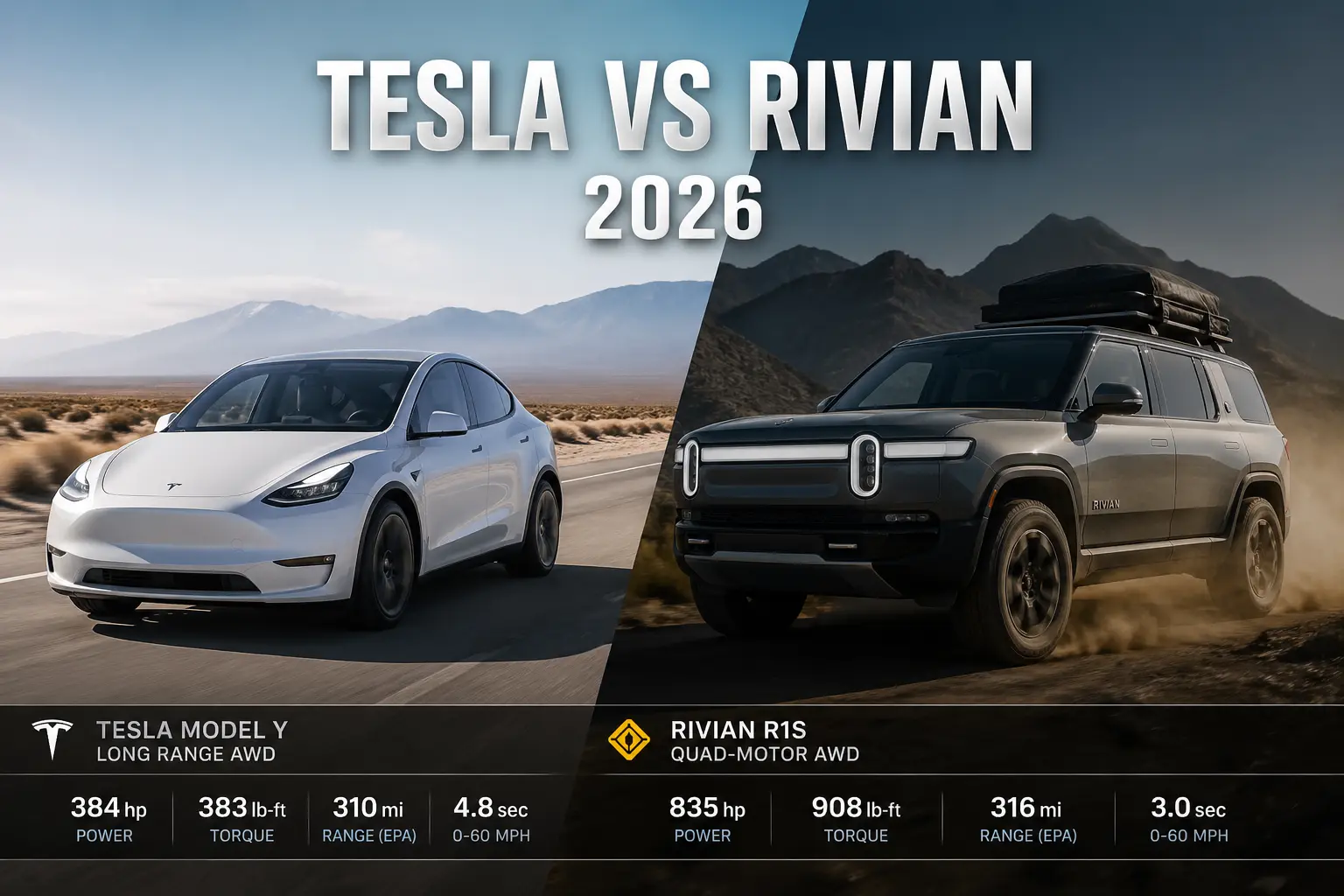
Tesla and Rivian represent pivotal advancements in electric vehicle (EV) technology. As of 2026, Tesla continues to dominate with its Model S Plaid, known for exceptional performance. Rivian, meanwhile, introduces R1T and R1S, focusing on robust utility and reliability. Performance metrics are crucial: both companies prioritize battery efficiency and charging speed. Safety features also differentiate them—Tesla emphasizes Autopilot systems; Rivian ensures superior off-road capabilities.
Electric vehicle technology is rapidly evolving. Innovations in battery chemistry improve range and reduce costs. Both Tesla and Rivian contribute significantly to this progress, but their approaches differ. Sustainability goals remain central; EVs play a vital role in reducing carbon emissions globally. Infrastructure developments support widespread adoption, with both companies influencing charging network expansion.
Comparing these two brands helps automotive enthusiasts and industry professionals understand future trends. For consumers, choosing between them depends on specific needs—performance or utility. Both models showcase cutting-edge technology, making comparisons essential for informed decisions.
Technical Comparison & Core Framework
Tesla and Rivian are leading electric vehicle (EV) manufacturers set to dominate the market by 2026. Tesla's Model S Plaid boasts a 3-second 0-to-60 mph acceleration, while Rivian R1T offers a towing capacity of up to 15,000 pounds.
Tesla excels in software integration and autonomous driving capabilities, as seen with its Full Self-Driving (FSD) Beta. Rivian focuses on off-road capability and a modular platform for various vehicle types, including trucks and vans.
In terms of battery technology, Tesla utilizes advanced lithium-ion cells for higher energy density. Rivian employs solid-state batteries under development for improved safety and efficiency.
Both companies invest heavily in sustainable manufacturing processes. Tesla's Gigafactories use renewable energy sources, while Rivian aims to achieve carbon neutrality by 2040.
For alternative options, consider Ford’s F-150 Lightning or General Motors' Hummer EV. The F-150 Lightning shares similarities with the R1T in towing capacity but lacks advanced autonomous features. GM's Hummer offers robust off-road capabilities and promises significant range improvements over time.
Considering performance, Tesla leads in acceleration and software integration. For versatility and ruggedness, Rivian stands out. Each vehicle has unique strengths, making their comparison complex based on individual needs.
Real-world Observations & Case Studies
Tesla and Rivian both have significant advantages in electric vehicle (EV) technology. Tesla leads with its established brand recognition and vast Supercharger network. Rivian excels in customization, particularly for commercial applications like delivery vehicles.
However, Tesla's extensive experience in EV battery management ensures longer-lasting batteries. Rivian’s modular architecture allows flexible manufacturing and product adaptation. Additionally, both companies focus on autonomous driving capabilities, yet Tesla has more real-world testing data with its Autopilot technology.
Therefore, Tesla might be superior for long-distance travel due to the extensive Supercharger network. Rivian, though, offers better options for specialized commercial use cases. For instance, their R1T pickup and R1S SUV models provide unique features suited to diverse industries.
In summary, choosing between Tesla and Rivian depends on specific needs. Both are pushing the boundaries in EV technology but cater to different market segments effectively. Another related topic is sustainable infrastructure development—both companies play crucial roles in expanding green transportation options.
Analysis of Pros, Cons & Risks
Tesla and Rivian represent two distinct approaches to electric vehicle (EV) technology in 2026. Tesla excels with a robust battery range and superior performance, yet faces high costs. Rivian focuses on advanced safety features and sustainable materials, but lags behind in market share.
Tesla's extensive brand recognition and established supply chain reduce initial risks for investors. However, the company’s high vehicle prices may limit consumer access. Rivian, though innovative with its electric architecture, lacks a broad product line, limiting diversification benefits.
Both companies leverage battery technology advancements. Tesla leads with longer ranges but faces higher production costs. Rivian prioritizes safety and sustainability, making vehicles more eco-friendly but potentially less efficient in range.
For investors considering risk mitigation, Tesla’s market leadership provides stability. Conversely, Rivian's focus on sustainable practices might appeal to environmentally conscious consumers, despite current challenges. Exploring both options can offer a balanced approach to electric vehicle investment.
Expert Verdict & Actionable Roadmap
Tesla's dominance in electric vehicle technology remains strong, but Rivian is gaining momentum with its advanced all-electric platforms. Both companies are pivotal in future automotive trends.
For 2026, Tesla’s Supercharger network will likely expand further, enhancing range anxiety solutions. However, Rivian's focus on commercial vehicles could tip the balance in favor of innovation and sustainability.
Rivian's electric architecture offers modular design flexibility, potentially leading to broader market adoption. Moreover, its commitment to zero-emission transportation aligns with global environmental goals.
In conclusion, Tesla’s experience and scale give it a solid edge today. Yet, Rivian's strategic focus on commercial vehicles might offer better value in the future.
Consider exploring sustainable transportation alternatives like hydrogen fuel cell vehicles for a broader automotive outlook.
Visual Guide

Further Exploration
- Must Read: Automotive (2026): Ultimate Guide, Reviews & Insights
- Related Guide: Is Electric Car Good for City Living? (2026)